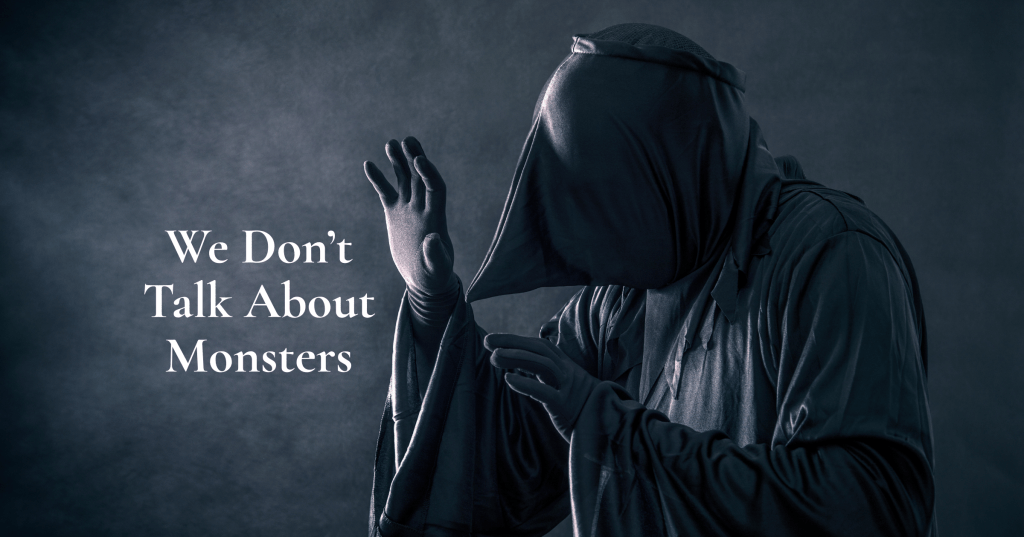
Halloween hands us easy monsters: plastic fangs, rubber masks, store-bought blood. They’re safe because we know they’re not real.
Real monsters dress better. They keep tidy lawns and shake your hand at the ballgame. They’re at every community service event. They spend their weekends helping neighbors with yard work or driving someone’s grandma to church.
Then they spread unfounded rumors about someone they’ve never spent time with. They convince you to vote how they want because it’s “what’s best for the community,” but in the end they’re the only one benefiting. They tell you how great your little town used to be before “those people” showed up. And then they dare you to challenge them, but with a smile on their face.
I think the best way to confront these entities is to recognize their disguises and then call them by their real names.
Revenant
If the South has a signature creature, it’s the Undying Lie — repeated so often it becomes reality. We’ve told ourselves heroic lies about our past until they’ve become the foundation of our Southern identity. We label it heritage. Or pride. But it’s actually a curse: one that keeps coming back, demanding to be fed. In horror terms, that’s a Revenant — a spirit of the past that won’t stay buried.
Possession
There’s also Respectable Cruelty — the monster that speaks softly and harms efficiently. It never raises its voice. It never uses a slur. It simply withholds: funding, compassion, access, acknowledgment. It smiles for the Christmas card and votes to close the local health clinic. It donates to the church building fund and guts the public library. In fiction, it’s a Possession. Real people don’t cackle as they do harm; they rationalize it. Something cold sits behind the eyes and whispers, This is for the best.
A Curse
Then we’ve got Sanitized Memory — the shape-shifter that edits the past until it looks presentable. School tours fawn over the pretty parts of history and hustle past the red-lined neighborhoods, the work camps, the unmarked graves under parking lots. Whole counties become a magic trick: now you see the uncomfortable facts, now you don’t. Horror understands this instinct; erasure is the first ingredient in any Curse.
Body Horror
And underneath it all is Self-Hate. Not loud, not theatrical — just a steady leak. When a culture is taught to worship a version of itself that never truly existed, it learns to despise the real thing. That contempt gets redirected: at neighbors, at outsiders, at anyone who refuses the script. In horror, self-hate is Body Horror. It’s the rot that starts inside and works its way out until the rot reaches everything — families, churches, towns, even the land itself.
The Hungry Thing
Drive through the places where Main Street is a row of empty smiles and sagging facades; then take the bypass lined with warehouses, chain stores, and a church in every third building. Small towns that traded identity for comfort. Consumers now finding themselves consumed by the very things they invited in. How quickly we traded oaks for asphalt, how eagerly we call it growth. That’s not progress; that’s avarice. It’s the Hungry Thing — a creature that only knows how to take and destroy, then calls the wreckage “opportunity.”
And we’ve been warned of these before. So many great literary minds and works have called them out.
Toni Morrison’s Beloved reminds us the past is not finished with us just because we’d rather it be; the house becomes a ledger, and the debt comes due. Jesmyn Ward’s Sing, Unburied, Sing lets the dead speak because the living refuse. These aren’t tales about capes and coffins; they’re reckonings. The monster is the gap between the story we tell and the truth we ignore.
Horror puts a face to what we’d rather call “complicated.” If you give Respectable Cruelty a voice, you can hear how it lies. If you let Sanitized Memory blur a map, you can feel yourself getting lost. If Self-Hate speaks through a family — through the body of a town — you can’t pretend it’s an abstract problem.
That’s the work I hope my stories can do: take the things we hide and make them undeniable. Not with lectures, but by forcing the monstrous faces to the surface. That doesn’t require capes or curses from the Old World. Our monsters are homegrown. Born here. Raised here. And too often, welcomed here.
And here’s the part we don’t like to admit: the antidote isn’t an exorcism; it’s truth. Tell the story straight. Name the thing. Horror is one of the last genres honest enough to say that some evil can’t be negotiated with; it has to be confronted directly.
This isn’t about hating the South. It’s about loving it enough to hold up a mirror to it. Love without truth curdles into worship, and worship of a false self is just another haunting. If there’s redemption for us — and I believe there is — it starts where the story stops being convenient.
So, this October, the plastic monsters will make their rounds. We’ll enjoy them as we always do. They’re doing a job: training wheels for fear. But the real work happens after the porch lights go dark — when we sit with the creatures we don’t name, the ones that run on denial and politeness and hunger. The question is whether we’ll ever drag them into the daylight.


Leave a comment